
Three answers before a download, not one
Paste a link and the first job is not downloading. The system has to answer: which platform is this, how does that platform hand over a video, and what is tried next when that fails.
The three answers live in three different places, and this article walks through all three.
A link is recognised by hostname, not by a substring, so a lookalike address does not slip through. Each source declares its own host list, and the first match wins.
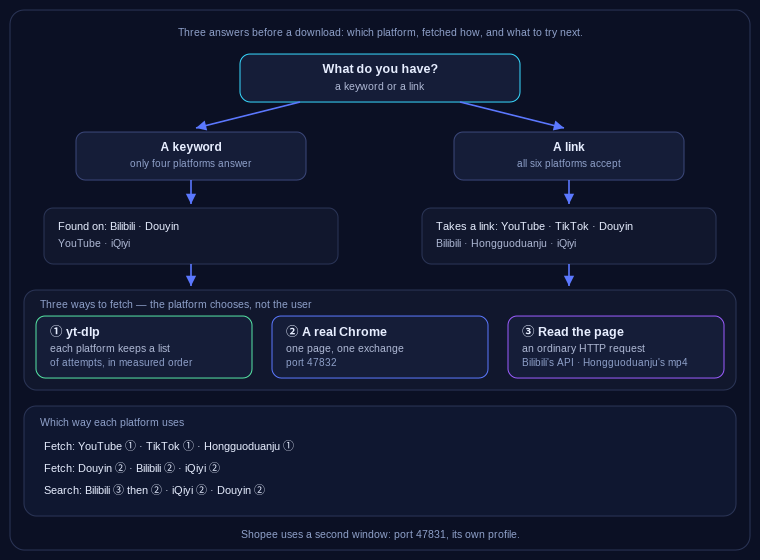
Four platforms answer a keyword, two accept only a link
Searching and downloading are different jobs, and a platform can be good at one without being able to do the other.
- Bilibili has a public search endpoint that needs no sign-in — so a search can be an ordinary HTTP request, with the search page as the fallback.
- Douyin is the opposite: its search page only renders for a signed-in browser, so the source opens a real page. If that page asks with a slider, clearing it needs a person.
- YouTube is searched through yt-dlp itself, with no API key and no login.
- iQiyi is searched in the page, and that page must open in the real window: its signature is computed by a function inside its own player.
TikTok and Hongguoduanju have no search at all. They only take a link you already have — not because it is hard, but because nobody has written their search half, and a fake search button is worse than no button.
Way one: yt-dlp, where every platform writes its own list of attempts
yt-dlp is not a button. It is a page reader, and every source here writes its own ordered list of attempts, sorted by measurement rather than taste. The same sentence — could not download — hides a different reason on every platform.
- YouTube: two attempts. The first is the tv_embedded client, the second is android — the one that still answers on a flagged address, even when the answer is degraded.
- TikTok: nine attempts, because it rejects any request without a real browser TLS fingerprint. In order: automatic impersonation, four named browsers, the mobile API, an alternate API host, the embed page, then a secUid rewrite.
- Hongguoduanju: no reader of its own, and none needed. yt-dlp’s generic reader can read the file address sitting in plain sight on the page, and it identifies as a browser when it downloads.
- Douyin: three yt-dlp attempts, and all three are last resorts — the first step is the ask from inside the page. All four rewrite the address to its canonical form, because the address you copy from a video that is open on the page is a modal form that yt-dlp’s reader does not recognise.
- Bilibili: the international bilibili.tv goes straight to yt-dlp, because the browser step declines that host. iQiyi: yt-dlp with PhantomJS is the second step and cannot run on this build — it is kept because a failure that names what is missing beats a failure that says nothing.
On bilibili.com, Douyin and iQiyi, yt-dlp is not the first step. On those three it is the last — what is tried after the real window has said no.
Way two: a real Chrome, because some walls do not open with cookies
Douyin is the expensive example, and it is expensive because a wrong answer was believed. yt-dlp says "fresh cookies are needed", but that is a guess: it calls the detail endpoint with fatal=False, swallows the 403, and blames the cookie jar.
On 13 October, ten combinations were measured against one video: a correct a_bogus signature, a self-minted ttwid, a 34-cookie jar, and a jar minted seconds earlier by a real Chrome. All ten came back with the same 46-byte block: Blocked by ArgusSecurityPlugin Uifid Not Found. Only a request issued from inside a page of that browser was answered.
The other two need that same window. bilibili.com does not hand yt-dlp its initial state — measured on 28 October — but the same page puts the stream list in a global variable, with two signed addresses for picture and sound; because there is no single address to hand a later step, those two are joined on disk straight away. iQiyi hands over nothing ready-made: the signature is computed per request and expires, and the function that computes it lives inside the page’s own player.
So the window is shared: one page at a time, one question at a time, and the page parked at about:blank when the exchange is over. Not for tidiness: a Douyin page left open with nobody asking costs 105–162% of a core, while about:blank costs nothing. On a machine with a screen you can point it at your own Chrome; otherwise it starts Chromium on a temporary profile.
Two windows, two profiles, and not port 9222
The window for Douyin, Bilibili and iQiyi listens on port 47832 with the .chrome-autoreel profile; the Shopee window listens on 47831 with .chrome-shopee. The profiles are separate because the jobs do not need to share a session, and one failing should not drag the other down.
Not 9222: that is the first port anti-fraud scripts probe, and a page can time it and tell an open port from a closed one. Nothing legitimate listens on 47831 or 47832, so a browser listening there says nothing about you.
One detail that can cost half a day: the window has to listen on every network address. Chrome binds to the local machine by default and answers 500 to a request with an unexpected host name — an error that reads exactly like "there is no browser there".
Way three: read it with an ordinary HTTP request
Not every wall needs a window. Bilibili search is the clearest example: its public API returns JSON, but measured on this machine it answers 412 to the server’s address even with a browser name and a Referer, while the search page still renders with title, duration and view count on every card. So the API goes first — it is cheaper when it answers — and the page is the fallback, which is where the window finally enters.
Hongguoduanju shows that "a browser" is not "cookies". Measured on 15 October: the same mp4 address answered 404 to two command-line tools — one that saves files, one that processes video — and 206 to a request carrying a browser name, with no cookies, no referer, one header. yt-dlp’s generic reader sends exactly that name, so it can download; a bare command cannot.
iQiyi is the hybrid case, and worth remembering for that: the signing step needs the window, but once a signature exists, every video segment is fetched with an ordinary HTTP request. One platform can need two of the three ways in a single download.
And the Hongguoduanju page offers one resolution: 360p, no ladder, no m3u8. Advice to "get cookies for a sharper copy" is wrong here, because there is no sharper copy to get.
Douyin: one page of a listing, not two
Listing a Douyin channel is the easiest place to over-promise. Its web page returns eighteen videos per page, measured against the live site. But the page’s signing SDK takes time to boot, and asking for page two right after page one returns 200 with an empty body.
Measured on 14 October: waiting three seconds gave the same; ninety seconds of retrying and a fresh page load before the ask gave the same. The profile grid draws eight videos by itself without being asked.
So the code does not pretend. A failed first page is raised — returning an empty list would be a lie. A failed later page stops the walk, keeps what is already in hand, and says how far it got. A hard brake at twenty-five pages keeps a wrong cursor from becoming a hung loop.
One failure, three different answers
A link is checked before a job starts. A Shopee link pasted into a video screen gets a sentence saying it is a product link and pointing at the right screen, rather than the generic "unsupported". A platform that needs the browser-impersonation package on a build that lacks it gets the missing piece named. Douyin and iQiyi need a browser, and say so while you are still looking at the button rather than ten seconds into a job.
One answer was wrong once and has been fixed: yt-dlp’s "Fresh cookies". The Douyin reader recognises that exact sentence and rewrites it — a fresh cookie jar will not help, because no jar opens this wall. Leaving the original sentence in place sends the reader after a file that cannot save anything.
Read the decision tree instead of guessing
- Have a link: read the hostname to name the platform. Have a keyword: only four platforms answer, and Douyin may ask with a slider.
- The platform picks its own list of attempts, cheap first, expensive after. Do not reorder them: every later step exists because an earlier one failed in a real case.
- If the wall is a browser — a signature, a check, a page that only renders when signed in — open the real window. If all you need is to read a page over plain HTTP, try that first: it is cheaper than a window.
- If an error mentions cookies, read it closely: there are platforms where cookies are not the variable.
Frequently asked questions
Why can’t TikTok and Hongguoduanju be searched by keyword?
Because their search half has not been written. The other four have verified search paths — Bilibili has a public endpoint, Douyin opens a real page, YouTube goes through yt-dlp, iQiyi reads its page. For TikTok and Hongguoduanju you paste the link to a specific video; that is a current limit, not a setting you got wrong.
Do I need to sign in to Douyin?
You need a real, signed-in Chrome window if you want to search or list a channel, because the page only renders for a signed-in session and may ask with a slider. For a specific video link the reader still tries asking from inside the page first; if that is refused it tries the other attempts and reports the reason for each.
Why two Chrome windows on two different ports?
Because they do different jobs. Port 47832 with its own profile reads Douyin and iQiyi; port 47831 with a separate profile posts to Shopee. Separate profiles mean signing in to Shopee does not touch the Douyin session, and closing one window does not break the other.
How many videos can be listed from a Douyin channel?
One page, eighteen videos, in practice. The second page is refused even after waiting and retrying, so the code keeps what it already has rather than failing the whole listing. If you need more, the right move is more sources or individual links, not waiting for a trick around it.
Automate the repetitive part
AutoReel does most of what these articles describe: reads the product, writes the script, builds the video, then publishes it to Shopee Video and Facebook/Reels. Rent it from $6.99 a month, or buy it once and keep it.