
A commercial product standing on open source is normal
There is a common misunderstanding: that using open source inside a product you sell is taking advantage. It is not. Almost everyone who wrote those libraries wrote them to be used — and being used in commercial software is still being used.
What they do not want is to be treated as unnamed free labour, or to have somebody take the code and sell back the very thing they are giving away.
So the question is not "am I allowed to use this" but "am I using it properly, and giving anything back". The licence answers the first; the rest of this article is the second.
A licence is not distant legal paperwork, it is an engineering condition
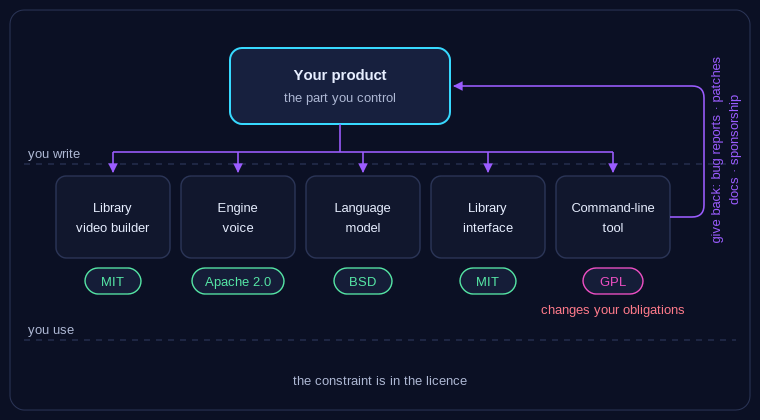
A library’s licence decides what you may do with it and what you owe in return. If you build products, you only need to tell two groups apart:
- The permissive group (MIT, BSD, Apache 2.0): use it, change it, sell it, ship it closed. Your only obligation is to keep the attribution and the original licence text. Apache 2.0 adds a sentence about patents, and that sentence is usually why people pick it for large libraries.
- The copyleft group (GPL, AGPL): you may still use it, but if you ship a product built on it, whoever receives that product must be able to get the source of that part. AGPL extends the obligation to the case where people only run it over a network instead of installing it.
- No licence at all: by default, all rights are reserved. No licence does not mean use it freely — it means you have not been granted anything.
- Licences that change between versions: the same library, permissive in an old version and stricter in a new one. Upgrading without re-reading is the most common way to walk into trouble.
Before adding a library, there are four questions to answer
- What is the licence, and is it in the copyleft group? If it is, the next question is whether you are willing to publish the related part. If you are not, do not add it.
- Who maintains it, and when was the last update? A library nobody edits is a library that will never get a security fix.
- How much else does it drag in? A small library can pull in twenty others, and you have just signed up to read twenty more licences.
- How long would removing it take? Whatever is hardest to remove should be what you read most carefully.
The real cost of a library is not money
Open source is free as in money, but it is not free. What you pay is time, and it arrives from four directions.
The first is upgrades. A library releasing a major version can break your code somewhere you never expected, and you only find out when it runs.
The second is abandonment: the library stands still while the operating system and the compiler move on, and a few years later it no longer installs.
The third is security: you have to know what you depend on in order to know what needs updating today.
The fourth, and the one nobody mentions, is misunderstanding. You think a library does job A, it actually does job B, and you discover that after building the whole pipeline on the wrong assumption.
There are five ways to give back without spending anything
Not everybody has money to sponsor with, and authors do not only need money. For a small team, the following are worth something real:
- A bug report somebody can reproduce. Not "it does not work", but the steps that show the same failure, on which version. A good report saves the maintainer hours, sometimes days.
- A patch with a test. For a library you use daily, fixing a small bug and sending it back is the cheapest way to repay — and the biggest beneficiary is you, because the next upgrade will not need your patch again.
- Documentation and translation. Plenty of good libraries get passed over only because their docs are hard to read. A working example, or a translated guide for whoever comes next, is a contribution nobody makes and everybody needs.
- Keeping the attribution. This is not optional — it is the condition of the licence, and the minimum courtesy.
- A small regular donation to the one or two libraries you depend on most. Small but steady, aimed where you genuinely cannot do without, means more than scattering it around.
Customers have a right to know what the product stands on
There is one more mistake worth avoiding: silence. The people who pay you have a right to know what the product stands on, and a complete attribution file says that without a long explanation.
The other direction is worse: do not use open source as a marketing badge. Free does not automatically mean good, and it does not automatically mean safe. It only means the code is public and anyone can read it — what matters is whether anyone actually has.
For a small product, doing three things is enough: know what you use and under what licence, keep the attribution, and every so often fix a bug and send it back. None of that needs a budget, only attention.
Frequently asked questions
A library uses the GPL. Can I still sell my product?
Yes, with conditions. If you ship a product built on it, whoever receives that product must be able to get the source of the related part. If you do not want that, do not use that library — or find one that does the same job under a permissive licence. This is not legal advice, so for anything large, ask a lawyer.
Is your product open source?
Our own code is not, and we do not promise it will be. The libraries we use keep their own licences, attribution is kept complete, and we send patches back for the bugs we hit.
Is open source riskier for security than writing it yourself?
Not really. Public code gets read by more people, and holes tend to be found faster. The real risk is elsewhere: a library nobody maintains has nobody fixing it, and a small, rarely used library has nobody reading it.
I have no money. How do I give back?
Reproducible bug reports, small patches, examples and translations, and keeping the attribution complete when you use something. All of it costs nothing and all of it is worth something to a maintainer.
Automate the repetitive part
AutoReel does most of what these articles describe: reads the product, writes the script, builds the video, then publishes it to Shopee Video and Facebook/Reels. Rent it from $6.99 a month, or buy it once and keep it.