
Writing it yourself sounds impressive until you have to maintain it
People new to this want to write every part themselves. It sounds reasonable: I understand it, I can fix it, I depend on nobody. But count what you are about to write.
A decent video encoder is years of work by a lot of people, with thousands of edge cases you only meet by hitting them. A Vietnamese speech engine that gets the tones right is its own research problem, not a small feature.
The problem is not whether you can write it. The problem is that once it is written, you maintain it forever.
Every time the operating system changes, every time a new input format shows up, you are the only person who fixes it. The product gains a step nobody uses and one more place to break.
Three things you should not write yourself
- Video encoding. Your graphics card already has a dedicated encoder chip, and the software encoder has been optimised across dozens of releases. Rewriting it means solving a problem that already has a better answer, in every respect except the one case you have not met yet.
- Vietnamese speech. Vietnamese carries tones, and the wrong tone is the wrong word. This is the kind of work where quality comes from training data, not from code.
- Language models. Nobody writes a language model for a video product. You use one through a provider and put your effort into the part that is yours.
What those three have in common: each already has a better answer outside your code, and none of them is where you are different. Your job is to use them well, not to rebuild them.
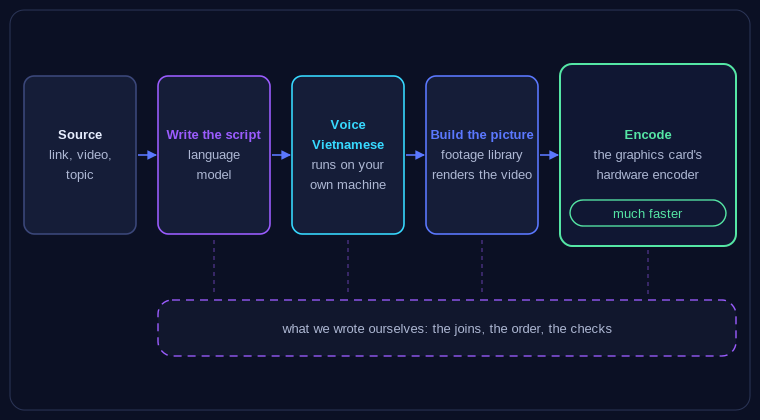
The whole pipeline is four jobs, and all four already have someone better at them
Encoding is the step worth the most money
Across the whole pipeline, encoding takes the most time and is the easiest step to improve. The same video, encoded on the processor and encoded on the dedicated chip, comes out as two very different durations — not a few percent, but a multiple.
What you pay is quality, and this is where a lot of people get it wrong. A hardware encoder produces a slightly larger file at the same quality setting, and some parameters need tuning by hand so fast movement does not smear. Get those parameters wrong and you have traded time for quality loss you can see.
How I handle it: use the hardware chip by default, but set the quality high enough, and keep the processor path as the fallback for machines without a suitable card. A product that only runs with a graphics card has already shown half its customers the door.
Speech runs on your machine, which is not what most services do
Most speech services today run in the cloud: you send the words up, you get an audio file back. That is fast, the voices sound good, and it costs your machine nothing. It also has three drawbacks, and for somebody selling online all three matter.
First, every video costs money, and there is no clear ceiling on that number. Second, no network means no video — while the rendering side works perfectly well on the machine. Third, your entire script leaves your computer, one sentence at a time.
So the speech engine here runs locally. A little slower than a strong server, but you can run it as much as you like, it needs no network, and the words never go anywhere.
The part you must write yourself is the glue
If the engines are not yours, what is this product really? It is the glue, and the glue is what a customer pays for:
- The order of operations. What runs first, what waits, what runs again after a failure. That is knowledge of the sales video trade, not of encoding.
- Checking the results. An engine returns a file and says it is done. Whether that file opens, runs the right length, has sound, has subtitles in the right place — the engine does not answer any of that.
- Script and rhythm. A thirty-second video for a Shopee product has its own structure, written by someone who does this for a living. No engine knows it.
- Assembly. Where the text sits, where the logo sits, how the voice lines up with the picture, how a template lands on the whole thing. This is what you see on the video, and the one part that cannot be bought.
- Policy and limits. Not inventing prices, not adding promises, not posting before approval. Engines have no concept of any of it.
Five questions to judge an engine before you trust it
- Does the licence let you use it in a commercial product? Read it first, not afterwards.
- Is anyone still maintaining it? Look at the last update and how many people are on it. An abandoned library is a debt, not a gift.
- Does it work without a network? If the answer is no, you have just added a point of failure you do not control.
- Can its output be checked by a machine? If you cannot confirm automatically that it did the right thing, you will be checking every video by eye.
- How expensive is it to remove? Every engine may have to be replaced. If it is scattered through your code, you have tied your own hands.
You sell glue, and that is not the weaker product
In the end, a product standing on other people’s engines is not a lesser product. It is a product that knows which fights are not worth having. You borrow what has already been solved, and put the effort into what nobody has solved: turning a manual video process into a button press, running on a seller’s own machine, with wording and rhythm that fit how people actually sell here.
Frequently asked questions
Does reusing engines mean worse video quality?
The opposite. Engines that many people have used for years usually produce better quality than something written from scratch, because they have met and handled an enormous number of edge cases. Video quality depends on the parameters you choose, not on who wrote the engine.
Does the product send my script to a server somewhere?
Speech and rendering run on your machine, so the words do not go anywhere. Only the step that asks a language model to write the script sends text out, through the provider you chose yourself.
My machine has no separate graphics card. Can I still use it?
Yes. It detects whether the machine has a suitable encoder chip. If it does, that path is much faster; if it does not, it falls back to encoding on the processor — slower, same result.
What happens if an outside engine stops working?
The local parts depend on nobody, so scripts already written and videos already rendered are still there. Only the step that asks a language model for a script needs a network, and that step does not affect videos that already have one.
Automate the repetitive part
AutoReel does most of what these articles describe: reads the product, writes the script, builds the video, then publishes it to Shopee Video and Facebook/Reels. Rent it from $6.99 a month, or buy it once and keep it.