
Generating text is the easy part
When people talk about AI in content production, they usually mean the writing: feed in a product, get back a description. That part is close to free now, and anyone can get it with a good enough prompt.
The hard part is elsewhere. Once the words exist, twenty more jobs remain: which voice, what renders the picture, where the subtitles sit, does the finished video open, retry or drop it when something fails, when to post. A language model does not know any of that on its own — but it can decide it, if you hand it the right tools and the right limits.
An orchestrator does four things, and the third is the one worth paying for
- Split the work. From a vague request — "make videos for this batch of products" — it builds a concrete list of jobs, each with a clear input and one engine responsible for it.
- Call the right engine. Each job has exactly one correct path. Picking the wrong engine does not fail immediately; it fails late and is hard to trace, so this part has to be strict rather than left to the model’s interpretation.
- Check the results. This is where the money is. Every engine hands back a result, and the orchestrator has to answer one question itself: is this usable.
- Decide what happens next. Pass, move on; fail softly, run it again; fail hard, stop and say so. Without this step, one small error floats down the whole pipeline.
One run: the model suggests, the code checks, the queue decides
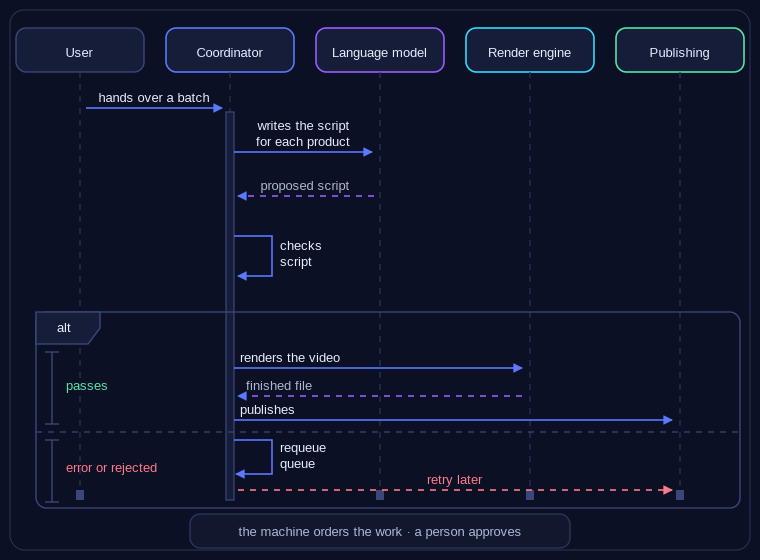
Checking the result is the part worth paying for, and it is not handed to the model
A language model answers fluently even when it is wrong. A script that reads beautifully can still be missing the price, name the wrong product, or run three times longer than the format allows. Use it as it comes and you find the mistake at the most expensive moment there is: after the video is rendered.
So the checks are split into three groups, and all three run automatically:
- Checks a machine can read: is the script length inside the allowed range, does the number of lines match the number of scenes, do the product name and price appear exactly as they do in the source data, is any line on the forbidden list.
- Checks on the finished product: does the video file open, is the duration right, is there sound, are the subtitles inside the frame, is any frame black.
- Checks across steps: does the voice match the script that was approved, does the footage match the scene count. This kind of error is rare, but when it happens it is almost impossible to spot by eye.
The important part: checking is not handed to the model. You can ask a model "does this script look fine", but that answer is only one more opinion. What is allowed to stop the pipeline has to be a check that runs in code and returns exactly two answers: pass or fail.
Four things a model must never decide alone
- Numbers and promises. Prices, promotions, warranty terms — a model may only copy these from data you supplied, never invent them. A wrong figure in a sales video is not a technical fault, it is a fault against your customer.
- Actions with effects outside the machine. Posting, sending messages, deleting files — none of it can be undone. A model may propose, but the final press belongs to a person, or to a rule written in advance.
- Retrying forever. A loop that says "try again until it passes" with no ceiling burns your money and your time. The number of attempts is yours to set beforehand, not the model’s to choose while running.
- Changing configuration. The model may not swap a template, change the default voice, or reorder the steps. It runs inside a frame you built, and that frame is edited by hand.
This approach has four limits, and the fourth one is yours
To be fair about it: this is not an autonomous system. It is a pipeline with one place that thinks. Four limits worth knowing before you expect too much:
- A model changes character between versions. The same prompt returns something different after a provider update, which is why anything depending on the output format has to be checked again rather than trusted.
- A model is confident when it is wrong. It has no concept of "I am not sure", so the question is not what the model said, but what you can verify.
- Cost scales with the number of calls. Every step that asks a model is a step you pay for. A pipeline that calls a model at every stage costs many times one that calls it at exactly one.
- Only verifiable things are verifiable. You can confirm a video has sound, the right length and every frame in place. You cannot automatically confirm it will sell. That judgement stays with you.
What you get instead is reviewing, not making every video
In exchange, the orchestrator solves the problem that actually belongs to this trade: volume. Thirty videos a day cannot be made by hand, and cannot be made by pasting prompts one at a time either.
With something deciding the order and a machine checking the results, quality evens out — the thirtieth video looks like the first, instead of depending on how rushed you were that day.
Your role changes with it: you stop making each video and start approving batches. A batch runs overnight, you look in the morning, fix two or three, publish the rest. That is the right level of automation for one person — enough to remove the repetition, not so much that it removes the judgement.
Frequently asked questions
Does the AI decide to publish videos by itself?
No. Posting cannot be undone, so it sits outside what a model may decide. You either approve the content first, or set a rule in advance; the final press is never the model’s to make.
If the AI writes a bad script, does it go straight into a video?
No. Whatever comes back has to pass automatic checks on length and on the product name and price against the source data. If it fails, the job goes back in the queue or stops with an error — it does not move on to rendering.
Do I pay extra for the AI orchestration part?
There is no extra charge for orchestration: it runs on your machine like the rest of the product. Beyond the product price, the only thing you pay for is the calls to the AI provider you picked for writing scripts, billed by them for what you use.
Is AI checking more reliable than a person checking?
No, and that is why the checks that can stop the pipeline run in code rather than through a model: is it long enough, is the product name right, does the file open. A model can offer an opinion, but it is not the gatekeeper.
Automate the repetitive part
AutoReel does most of what these articles describe: reads the product, writes the script, builds the video, then publishes it to Shopee Video and Facebook/Reels. Rent it from $6.99 a month, or buy it once and keep it.